

Published Paper
Modelling groundwater flow in the Plaine du Nord-Massacre shallow aquifer, Haiti (Arnaud, Gutierrez, Zegoulli & Gonomy)
Published On:
April 21, 2022
Written by:
Joshua Davis
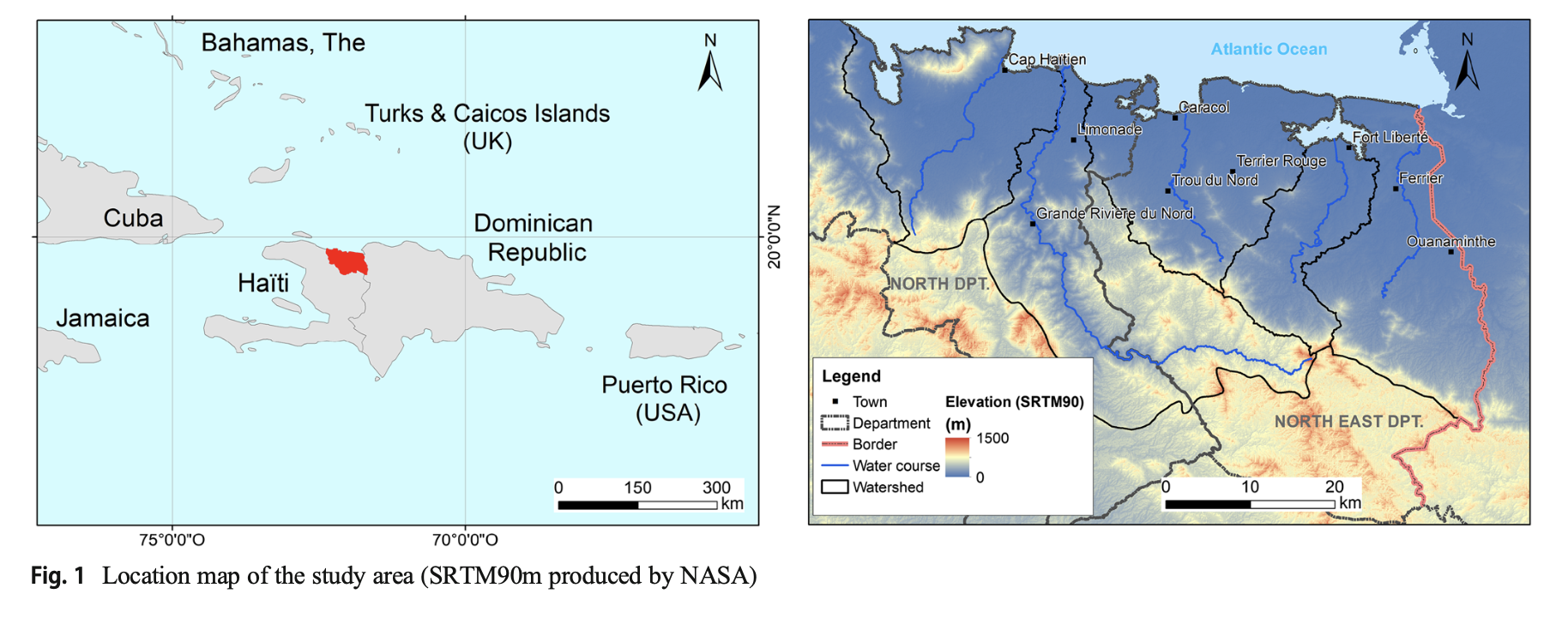
This study by Luc Arnaud, Alexis Gutierrez, Ines Zegoulli, and Nyankona Gonomy builds a regional-scale groundwater flow model (using the MARTHE finite-difference code) for the shallow alluvial Plaine du Nord-Massacre aquifer in northern Haiti, developed under the USAID-funded AVANSE project to support sustainable expansion of irrigated agriculture (mainly banana cultivation) in the region. Due to a near-total lack of monitoring data, the model was calibrated only under steady-state conditions using historical piezometric, river-flow, and drilling records, then run in a theoretical transient mode to test a proposed irrigation scenario involving 270 new boreholes across 11 target zones.
The steady-state water balance shows the aquifer holds significant, currently under-tapped groundwater resources overall. But the irrigation scenario revealed a key operational constraint: pumping for the new boreholes would produce drawdowns of 6-7 m in some areas (notably around Terrier Rouge, Caracol, and Ouanaminthe) - far more than the 3-6 m depth of most existing wells - meaning new agricultural wells will need to be sited deeper than 20 m to avoid running dry. The model also flags a related risk: in low-lying coastal areas near Cap-Haitien and Caracol, where simulated groundwater levels sit close to sea level, combined agricultural and industrial pumping during drought (as observed in 2014-2016) increases the risk of saltwater intrusion.
Key takeaway: This is primarily an irrigation-planning tool, not a saline-intrusion study - its main finding is that new agricultural wells for the AVANSE project need to be drilled significantly deeper (>20 m) than existing shallow wells to sustain the proposed irrigation scenario. Saltwater intrusion risk near the coast under drought/heavy pumping is a secondary, geographically specific finding (Cap-Haitien and Caracol areas). The authors recommend continued monitoring and transient-state calibration as more data becomes available.
Published online 21 April 2022 (Hydrogeology Journal 30:1399-1415); part of the "Advancements in hydrogeological knowledge of Haiti" topical collection.
Keep reading this paper by downloading the PDF below.
We Support Safe Water Access
Learn more about how our team brings fresh water to others with technical excellence and integrity.
Learn More