

Published Paper
Modelling groundwater flow in the Plaine du Nord-Massacre shallow aquifer, Haiti (Arnaud, Gutierrez, Zegoulli & Gonomy)
Publicado el:
April 21, 2022
Written by:
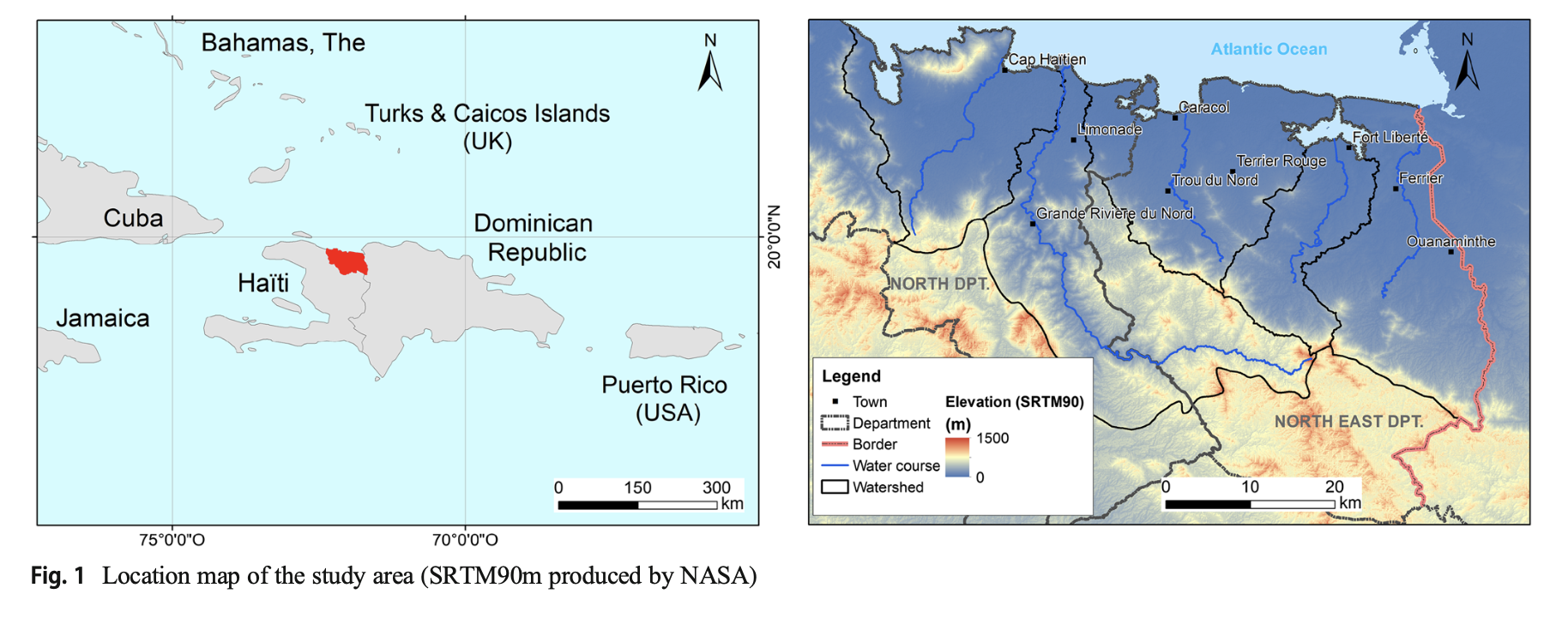
This study by Luc Arnaud, Alexis Gutierrez, Ines Zegoulli, and Nyankona Gonomy builds a regional-scale groundwater flow model (using the MARTHE finite-difference code) for the shallow alluvial Plaine du Nord-Massacre aquifer in northern Haiti, developed under the USAID-funded AVANSE project to support sustainable expansion of irrigated agriculture (mainly banana cultivation) in the region. Due to a near-total lack of monitoring data, the model was calibrated only under steady-state conditions using historical piezometric, river-flow, and drilling records, then run in a theoretical transient mode to test a proposed irrigation scenario involving 270 new boreholes across 11 target zones.
The steady-state water balance shows the aquifer holds significant, currently under-tapped groundwater resources overall. But the irrigation scenario revealed a key operational constraint: pumping for the new boreholes would produce drawdowns of 6-7 m in some areas (notably around Terrier Rouge, Caracol, and Ouanaminthe) - far more than the 3-6 m depth of most existing wells - meaning new agricultural wells will need to be sited deeper than 20 m to avoid running dry. The model also flags a related risk: in low-lying coastal areas near Cap-Haitien and Caracol, where simulated groundwater levels sit close to sea level, combined agricultural and industrial pumping during drought (as observed in 2014-2016) increases the risk of saltwater intrusion.
Key takeaway: This is primarily an irrigation-planning tool, not a saline-intrusion study - its main finding is that new agricultural wells for the AVANSE project need to be drilled significantly deeper (>20 m) than existing shallow wells to sustain the proposed irrigation scenario. Saltwater intrusion risk near the coast under drought/heavy pumping is a secondary, geographically specific finding (Cap-Haitien and Caracol areas). The authors recommend continued monitoring and transient-state calibration as more data becomes available.
Published online 21 April 2022 (Hydrogeology Journal 30:1399-1415); part of the "Advancements in hydrogeological knowledge of Haiti" topical collection.
Keep reading this paper by downloading the PDF below.
Apoyamos el acceso a agua segura
Descubra cómo nuestro equipo lleva agua potable a otras personas con excelencia técnica e integridad.
Más información
