
Published Paper
Topical Collection: Advancements in hydrogeological knowledge of Haiti for recovery and development (Adamson, Gutierrez, Perez-Monforte, Rodriguez-Vera, LaVanchy, Jean-Baptiste, Emmanuel, Moliere, Gelting, Miner & Dykstra)
Published On:
August 8, 2022
Written by:
Joshua Davis
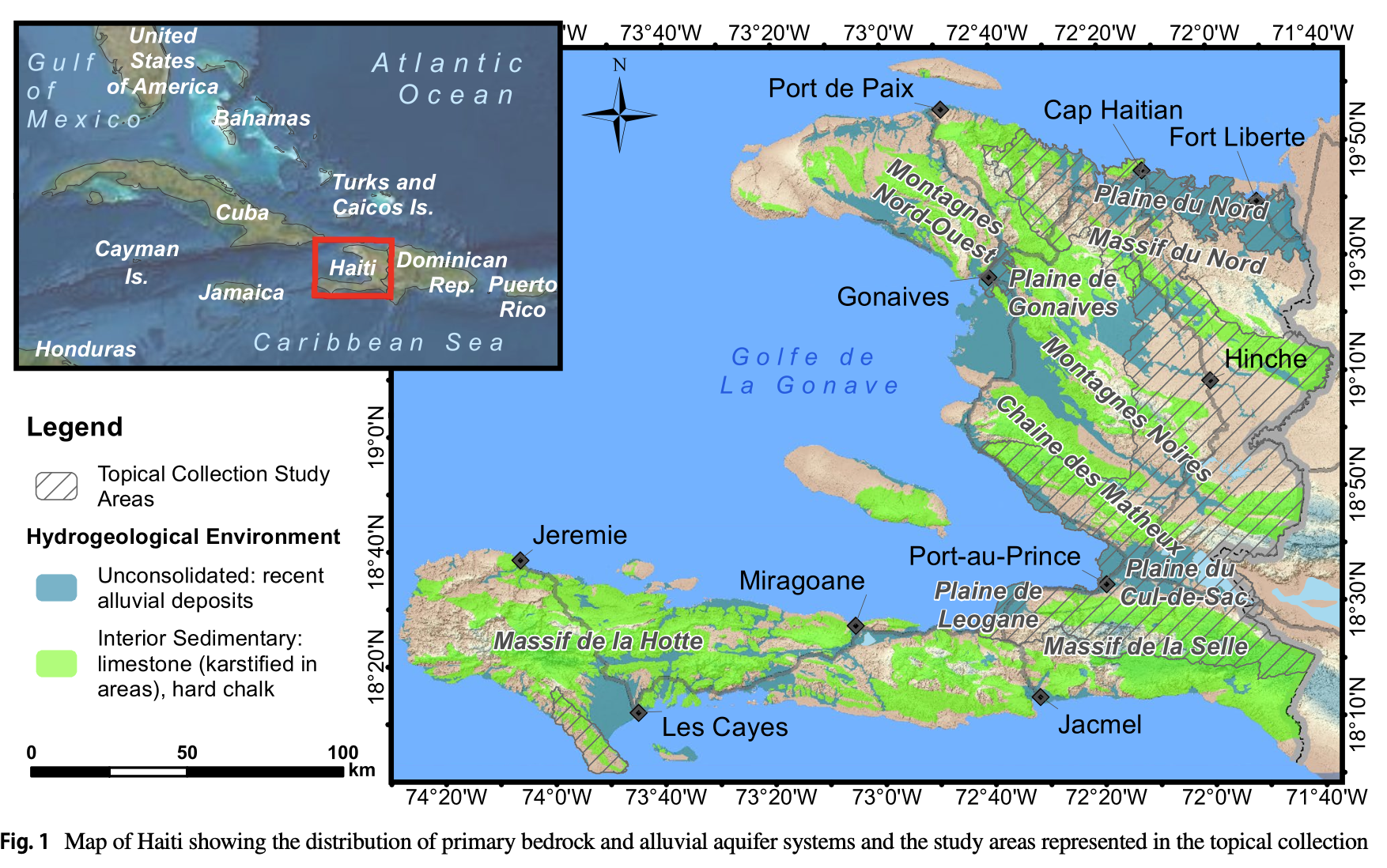
This essay by James K. Adamson, Alexis Gutierrez, Sergio Perez-Monforte, Maria Rodriguez-Vera, G. Thomas LaVanchy, Gerald Jean-Baptiste, Evens Emmanuel, Emmanuel Moliere, Richard Gelting, Wm Javan Miner, and Stuart Dykstra introduces a topical collection of seven peer-reviewed articles advancing hydrogeological knowledge of Haiti, a country where groundwater is the primary water source for a population exceeding 11.4 million but remains poorly studied and documented. It traces how political and economic instability, limited public investment, and repeated disasters (the 2010 and 2021 earthquakes, the 2015-2016 drought, and the 2010 cholera outbreak) have hampered water security progress despite major international investment following the 2010 earthquake.
It then previews the collection's seven studies, which together document Haiti's largest alluvial aquifers (Plaine du Nord, Plaine du Cul-de-Sac, Plaine de Leogane, Plaine de Gonaives) and mountain bedrock "water tower" aquifers (chiefly the Massif de la Selle), plus a new national stable-isotope database. A recurring theme is that Haiti's alluvial aquifers depend heavily on recharge from rivers and infiltration originating in the bedrock mountain ranges, and that this recharge is closely tied to El Nino/La Nina precipitation cycles.
Key takeaway: Only 4.5% of Haiti's population gained basic water access between 2010 and 2020 despite heavy post-earthquake investment (bringing total access to 66.7%). The collection argues that closing data and research gaps - and publicly sharing findings - is essential to inform sound groundwater governance, protect aquifer recharge areas, and guide Haiti's recovery and development.
Published online 8 August 2022 (Hydrogeology Journal 30:1345-1348).
Keep reading this paper by downloading the PDF below.
We Support Safe Water Access
Learn more about how our team brings fresh water to others with technical excellence and integrity.
Learn More