

Published Paper
The use of water stable isotopes for a better understanding of hydrogeological processes in Haiti: overview of existing d18O and d2H data (Gourcy, Adamson, Miner, Vitvar & Belizaire)
Published On:
May 25, 2022
Written by:
Joshua Davis
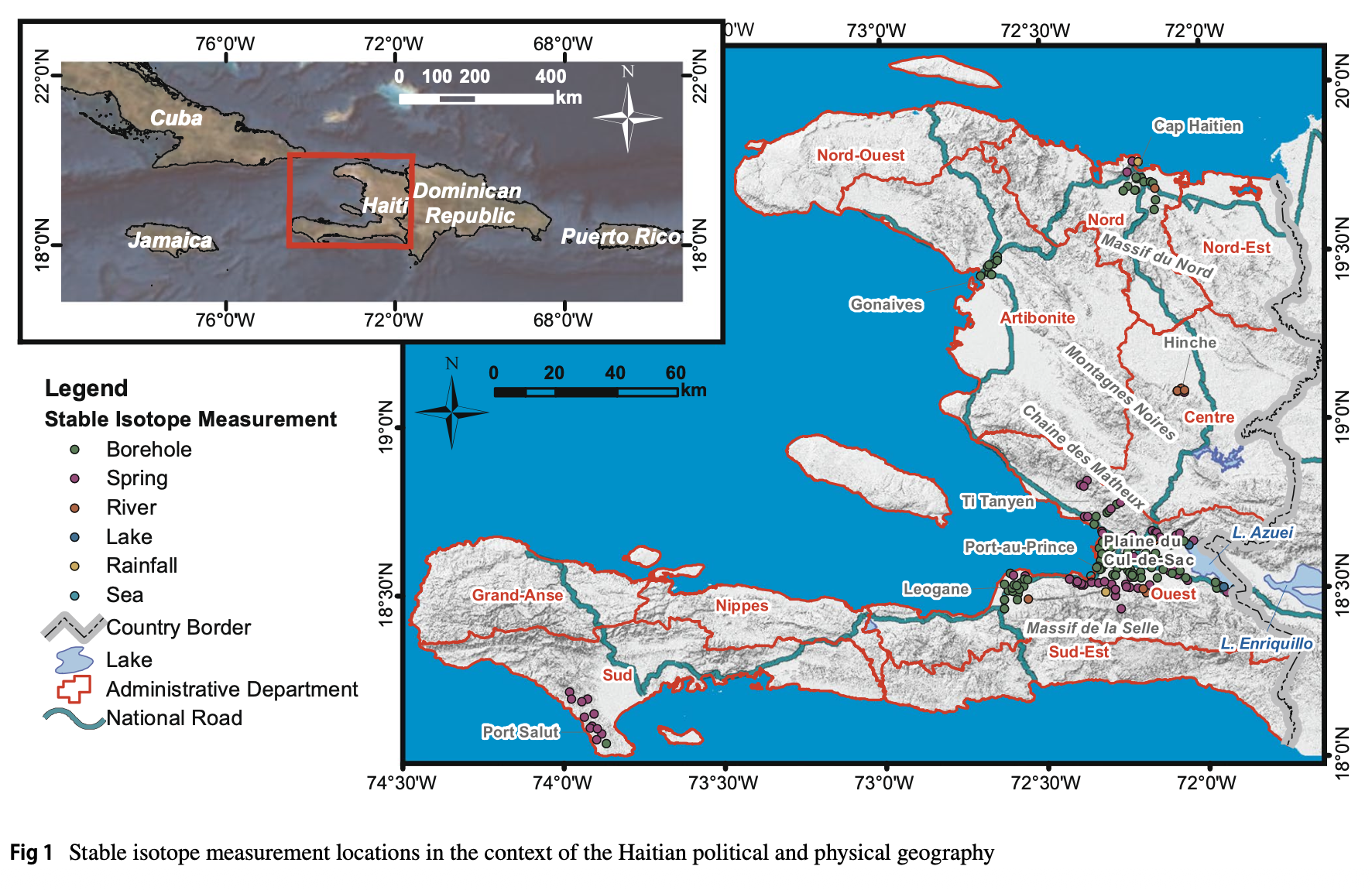
This study by L. Gourcy, J.K. Adamson, W.J. Miner, T. Vitvar, and D. Belizaire compiles the first unified database of stable water isotope data (delta-18O and delta-2H) collected in Haiti since 1987, drawing together 11 previously scattered and mostly unpublished datasets into 248 results from 190 locations nationwide. The authors reviewed each dataset for quality and consistency, covering precipitation, lakes, rivers, springs, and boreholes across Haiti's five major hydrogeological environments.
Using this consolidated dataset, they proposed Haiti's first local meteoric water line (delta-2H = 7.2 x delta-18O + 8.8), a reference used to interpret where and how groundwater is recharged, and calculated an altitude effect for freshwater springs in the Plaine du Cul-de-Sac/Massif de la Selle area of about -6.67 per mil per 100 m for delta-2H and -0.09 per mil per 100 m for delta-18O.
Key Takeaway: Isotope data is a cost-effective, powerful tool for understanding how and where Haiti's aquifers are recharged. The new database and meteoric water line give researchers and water managers a foundational reference for future studies, though the authors note the dataset is still limited for country-level conclusions and call for a permanent Haitian precipitation-monitoring station to refine it further.
Published online 25 May 2022 (Hydrogeology Journal 30:1387-1397); part of the "Advancements in hydrogeological knowledge of Haiti" topical collection.
Keep reading this paper by downloading the PDF below.
We Support Safe Water Access
Learn more about how our team brings fresh water to others with technical excellence and integrity.
Learn More