

Published Paper
Geological and hydrogeological assessment of the Brito Formation: Municipio de Tola, Nicaragua (Adamson, LaVanchy, Stone, Clark, Dykstra & Taylor)
Published On:
July 1, 2021
Written by:
Joshua Davis
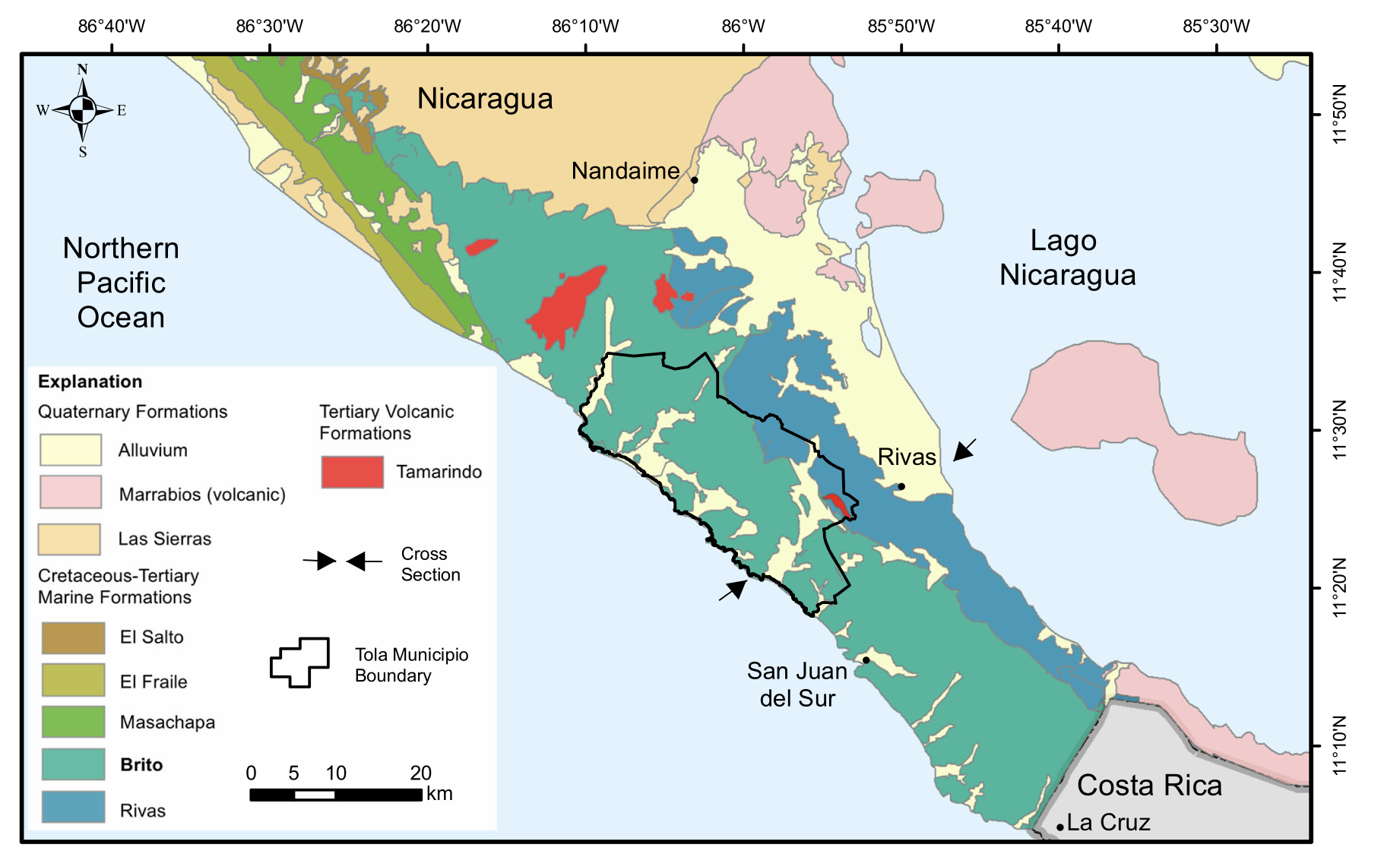
This peer-reviewed article, published in Hydrogeology Journal in 2021, presents a geological and hydrogeological assessment of the Brito Formation, the primary aquifer system supporting Tola municipality on Nicaragua's Pacific coast. It draws on fieldwork, well records, water quality sampling, rock and isotope analysis, and geologic mapping collected by the authors between 2012 and 2016 - a period that included the severe 2015-2016 El Nino drought - to build a detailed conceptual hydrogeological model for a region where groundwater data has historically been sparse.
The study found the Brito Formation, a marine sandstone unit over 2,500 m thick, to be a heterogeneous aquifer with low primary porosity; groundwater storage and flow depend mainly on secondary porosity created by fracturing and faulting. Recharge (estimated at roughly 258 mm/year on average) is spatially and temporally uneven, with infiltration from streamflow and runoff early in the rainy season contributing disproportionately. Water quality varies by position in the regional flow system, with localized seawater and geothermal influences near the coast. Because of its limited storage capacity and reliance on episodic recharge, the authors conclude the aquifer is especially vulnerable to overabstraction, drought, and climate change, and they recommend continued monitoring and regional-scale study spanning the Brito and adjoining Rivas formations to support sustainable groundwater management.
Published 1 July 2021 (Hydrogeology Journal, Volume 29, pages 2285-2304).
Keep reading this paper by downloading the PDF below.
We Support Safe Water Access
Learn more about how our team brings fresh water to others with technical excellence and integrity.
Learn More