

Instructional
Anatomy of a Properly Sealed Borehole: Design & Construction Explained
Published On:
September 23, 2026
Written by:
Joshua Davis
Building a Borehole the Right Way, From the Bottom Up
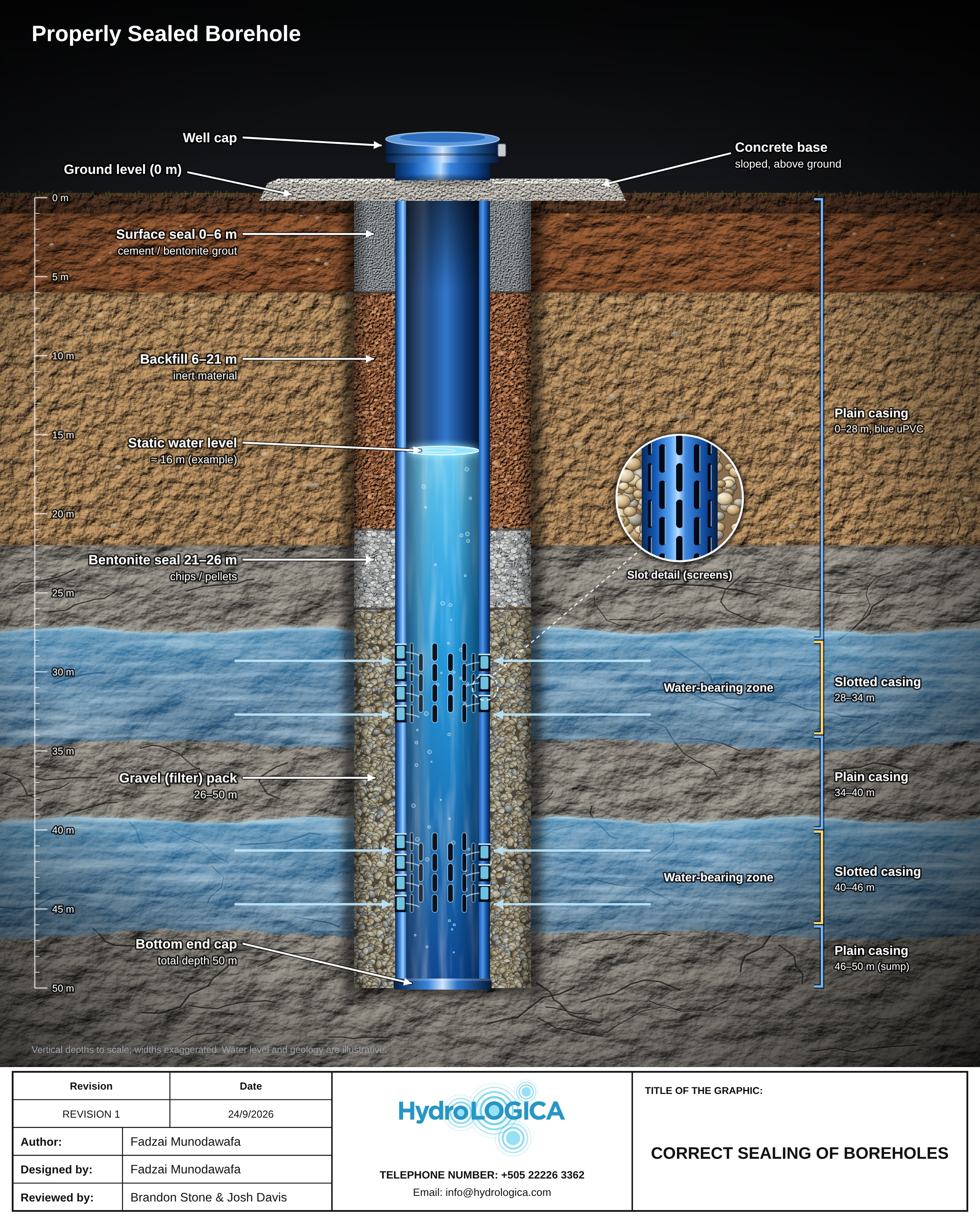
Proper borehole construction isn't just about drilling deep enough to hit water, every layer of the design plays a role in protecting that water from contamination. Here's how a properly sealed borehole comes together, starting from the bottom.
Setting the Screen
At the base of the borehole, a bottom end cap seals off the very bottom of the casing. Just above it, the screen (slotted casing) is centered within the borehole, not off to one side, so there's uniform annular space all the way around it.
This centering matters: an off-center screen creates uneven flow paths and weak spots in the surrounding seal, exactly like the "dead spots" that cause channeling and reduced filtration.
Matching Casing to the Geology
The design alternates between slotted and plain casing based on what's actually underground:
- Slotted casing is placed only within water-bearing zones (in this example, 28–34 m and 40–46 m), allowing groundwater to enter the well
- Plain casing runs through everything else, between water-bearing zones and up through the backfill to the surface, keeping non-target zones sealed off from the well interior
Packing the Screen
Once the casing is in place, a gravel (filter) pack is installed around the slotted sections. This pack filters out fine sediment while allowing water to flow freely into the screen. A layer of bentonite is placed above the gravel pack, acting as a seal to prevent surface water or shallow contamination from migrating down into the water-bearing zones below.
Backfilling Above the Water Zone
Moving up from the bentonite seal, the annular space is backfilled with inert material, in this example, spanning roughly 6 to 26 meters. This backfill occupies the space between the deeper protective seal and the surface seal, without providing a contamination pathway of its own.
Sealing the Surface
The final and most critical protective layer is the surface seal—typically the top 6 meters (about 20 feet) of the borehole—made of cement or bentonite grout. This seal is what prevents surface runoff, spills, and shallow contamination from ever reaching the annular space and traveling down into the aquifer.
Finishing at Ground Level
Above the surface seal, a concrete base is installed above ground level, sloped to shed water away from the borehole. The well cap sits on top, completing the seal and keeping surface contaminants from entering the well from above.
Why Every Layer Matters
Each component in this cross-section serves a specific protective function. Skip the bentonite seal above the gravel pack, and shallow contamination can migrate down. Skip the surface seal, and runoff has a direct path into the annulus. Off-center screens undermine the gravel pack's effectiveness. A properly sealed borehole isn't one design choice, it's the sum of all of them, done right, from the bottom of the hole to the well cap.
Download the borehole cross section below
We Support Safe Water Access
Learn more about how our team brings fresh water to others with technical excellence and integrity.
Learn More