

Published Paper
Reconnaissance of the Diquini and Mariani springs and insights regarding the Massif de la Selle karst aquifer of Haiti (Miner, Adamson & Rochat)
Publicado el:
June 8, 2022
Written by:
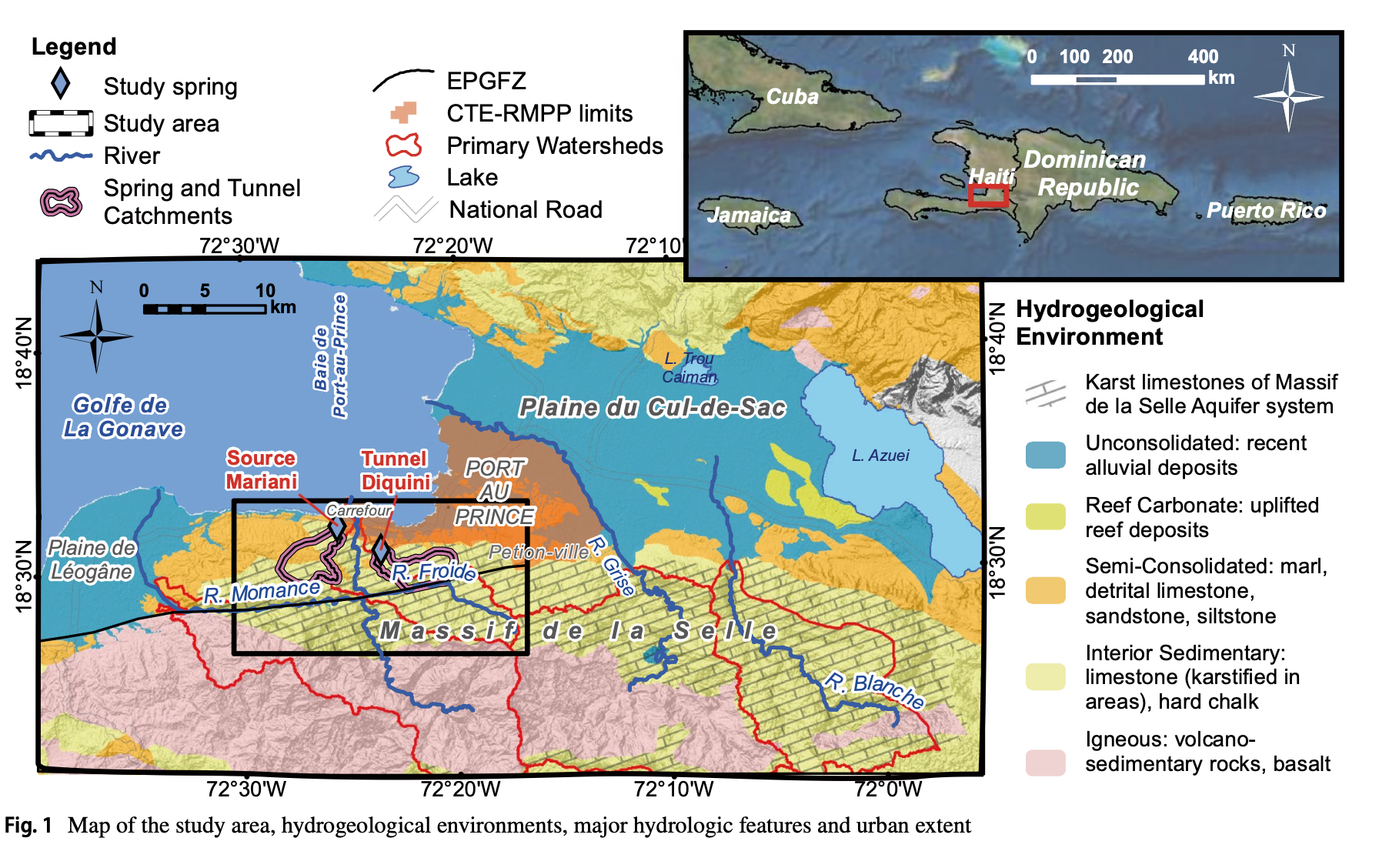
This paper by Wm Javan Miner, James K. Adamson, and Pierre-Yves Rochat presents a field reconnaissance of Tunnel Diquini and Source Mariani, the two largest water sources supplying the Port-au-Prince municipal water system (RMPP) in Haiti - together they account for about 42% of total municipal production, out of the roughly 65% of RMPP supply that comes from 15 springs and two tunnels draining the Massif de la Selle karst aquifer. Both discharge from Eocene-age limestone, yet had almost no prior data or study despite their importance, especially amid concerns over decreasing flows and a proposed river diversion scheme nearby.
Using field reconnaissance plus stable-isotope, tracer, and chloride-mass-balance techniques, the authors built an initial framework for the springs' flow regimes, water origins, and recharge dynamics. Average annual discharge is estimated at 10.8 Mm3/year for the tunnel and 7.1 Mm3/year for the spring.
Key Takeaway: Recharge to this part of the aquifer varies with rainfall intensity and multi-year (3-7 year) climatic cycles rather than following a steady decline - flows spiked in 2007-2010 and have since receded to historical norms. Neither spring appears connected to the River Momance, though the tunnel may connect to the River Froide. The findings confirm the Massif de la Selle's regional importance for current and future Port-au-Prince water supply.
Published online 8 June 2022 (Hydrogeology Journal 30:1349-1366); part of the "Advancements in hydrogeological knowledge of Haiti" topical collection.
Keep reading this paper by downloading the PDF below.
Apoyamos el acceso a agua segura
Descubra cómo nuestro equipo lleva agua potable a otras personas con excelencia técnica e integridad.
Más información
