

Instructional
Air Drilling Variations
Publicado el:
August 26, 2026
Written by:
Fadzai Munodawafa
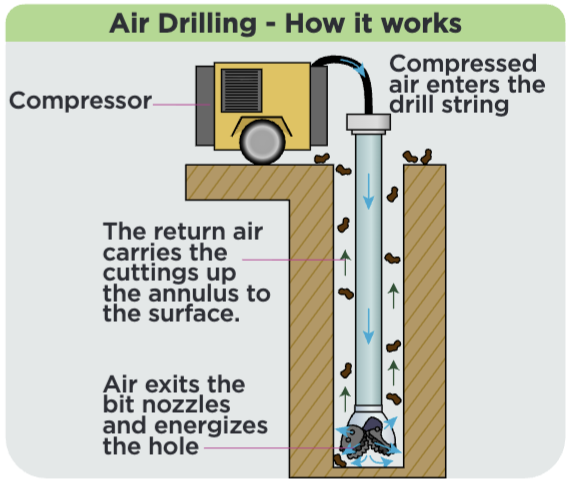
Air drilling methods are widely used in groundwater development, mineral exploration, geotechnical investigations, and construction drilling because of their speed, reduced formation damage, and ability to drill consolidated formations efficiently. Unlike conventional mud rotary systems that depend primarily on drilling fluids for cuttings transport and borehole stabilization, air drilling systems use compressed air either alone or in combination with water, polymers, foaming agents, or surfactants.
Several drilling system options exist when air is used as the drilling fluid:
• Air only (dry air)
•Air and a small volume of water (mist)
•Air, a small volume of water, and a small amount of surfactant
• Air-foam
•Stable foam-air and surfactant
•Stiff foam-air, surfactant, and high-molecular-weight polymer or bentonite.
•Aerated drilling fluid—water- based drilling fluid and air
Factors to consider when deciding which of these systems to use include the volume of water entering the borehole, the penetration rate, the volume of air available, the nature of the formations being drilled, and environmental conditions affecting the drilling process.
To find out more, please look at the technical bulletin below
Keep reading this Technical Bulletin by downloading the PDF below.
Apoyamos el acceso a agua segura
Descubra cómo nuestro equipo lleva agua potable a otras personas con excelencia técnica e integridad.
Más información
